PolicyClown
Satirical AI political forecasts where real headlines enter the clown car.
Visit PolicyClown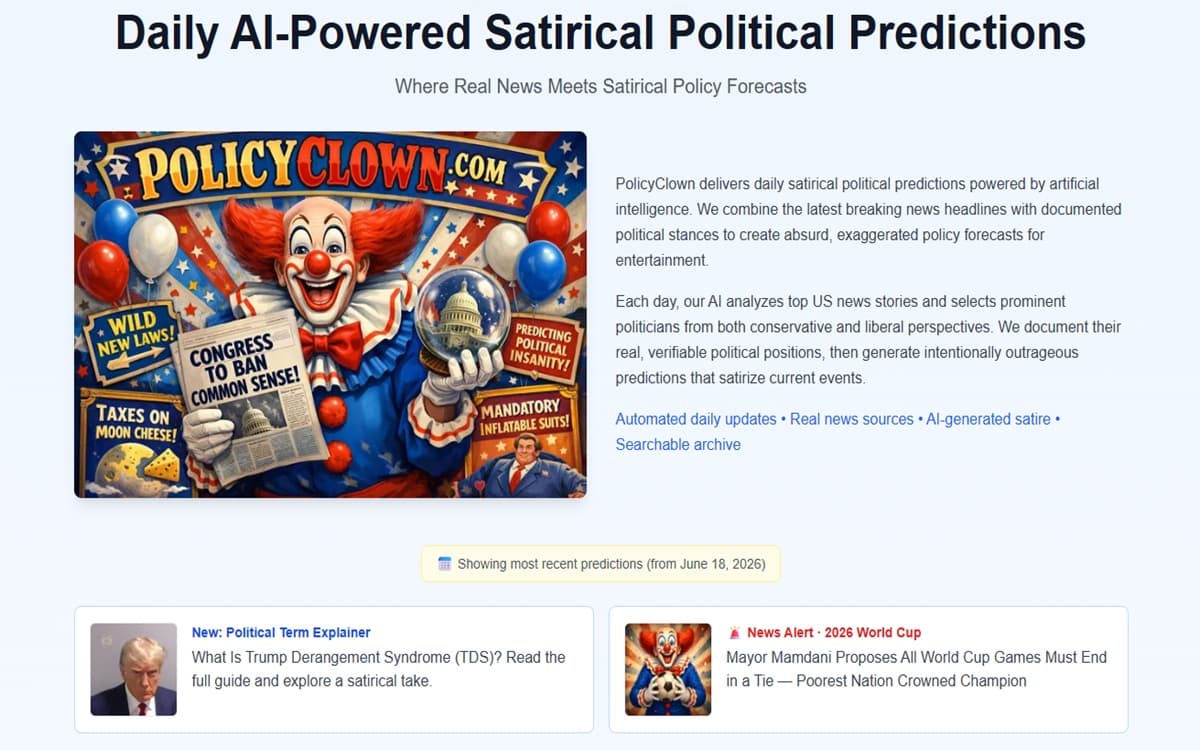
What PolicyClown does
PolicyClown is a satirical political website with a very clear joke: take real headlines, connect them to documented political stances, and let AI spin the combination into intentionally ridiculous fake policy predictions. The result is not campaign analysis, polling, or a serious forecast. It is political absurdity on purpose, labeled as entertainment and built around the comic gap between what a politician has actually supported and the wildly exaggerated policy the site pretends might come next.
The public homepage shows the formula in action. Each prediction card starts with a current news story, names a politician, lists real political stances, then presents an absurd AI-generated policy forecast. The archive makes the joke browsable over time, while the detail pages show the source headline, date, politician, stance bullets, and the full satirical prediction. Supporting pages such as Satire 101, the glossary, FAQ, and resources help explain the context around the humor.
Who it may help
PolicyClown may help readers who enjoy political comedy, experimental AI projects, and media-literacy examples that are more memorable than a lecture. It is a natural fit for people who like The Onion-style exaggeration, political cartoons, late-night monologues, or fake-news formats that are clearly presented as jokes. The site can also help teachers, writers, and discussion leaders show how satire works when it starts with real events but pushes them beyond plausibility.
Its educational value comes from the label and the structure. Visitors can see the difference between a real headline, a documented stance, and the fictional prediction that follows. That makes PolicyClown useful as a playful reminder that context matters. The joke works because the site signals that the prediction is invented, exaggerated, and not meant to be mistaken for news.
How it connects to the AI revolution
AI Revolution Atlas looks at how AI changes creativity, communication, trust, and interpretation. PolicyClown fits that story as a lively example of AI as a creative medium. The site does not simply ask AI for a generic joke. It gives the system ingredients: a headline, political context, a selected public figure, and a desired satirical frame. The output depends on those choices.
That makes the site useful for AI literacy. Generated media is never just content floating in space. It has a prompt, a purpose, a tone, a source context, and an audience expectation. PolicyClown shows why those signals matter. The same AI system that can summarize or explain can also parody, exaggerate, and invent. Readers need to notice the difference, especially around politics, where humor, misinformation, commentary, and persuasion can blur if labeling is weak.
Why visitors may enjoy it
The enjoyable part of PolicyClown is the gleeful escalation. A serious headline becomes the setup. A politician’s documented stance becomes the springboard. Then the fake policy prediction jumps into full clown logic: overbuilt legislation, theatrical mandates, cartoonish bureaucracy, and policy language stretched until it snaps. The humor comes from seeing real political habits inflated to absurd scale.
The site also rewards browsing. The archive lets visitors search and filter past predictions, while the glossary turns political jargon into a cheeky survival guide. Satire 101 adds a more reflective layer by explaining exaggeration, irony, parody, truth-based humor, and the difference between satire and misinformation. That combination makes PolicyClown more than a random joke feed. It is a small satirical lab where visitors can laugh, then think about how political language works.
A practical next step
Start on today’s predictions and pick one card where you already understand the real issue. Read the headline, the stance bullets, and the absurd forecast in that order. Then ask yourself what makes the joke work. Is it exaggerating a real policy instinct? Is it parodying a talking point? Is it turning political language into something visibly silly?
That small reading habit captures the best use of PolicyClown. Enjoy the joke in its original setting, keep the satire label in mind, and use the experience as a reminder that AI-generated media depends on framing. For AI Revolution Atlas readers, PolicyClown is a fun stop in the portfolio because it shows AI not only as a productivity tool, but as a creative engine for parody, commentary, laughter, and media awareness.
Evaluate thoughtfully
Is this tool a fit for your goals?
 Ask Dr. Mira