GuidedPhysics
AI-guided physics learning that makes hard ideas easier to enter, question, and practice.
Visit GuidedPhysics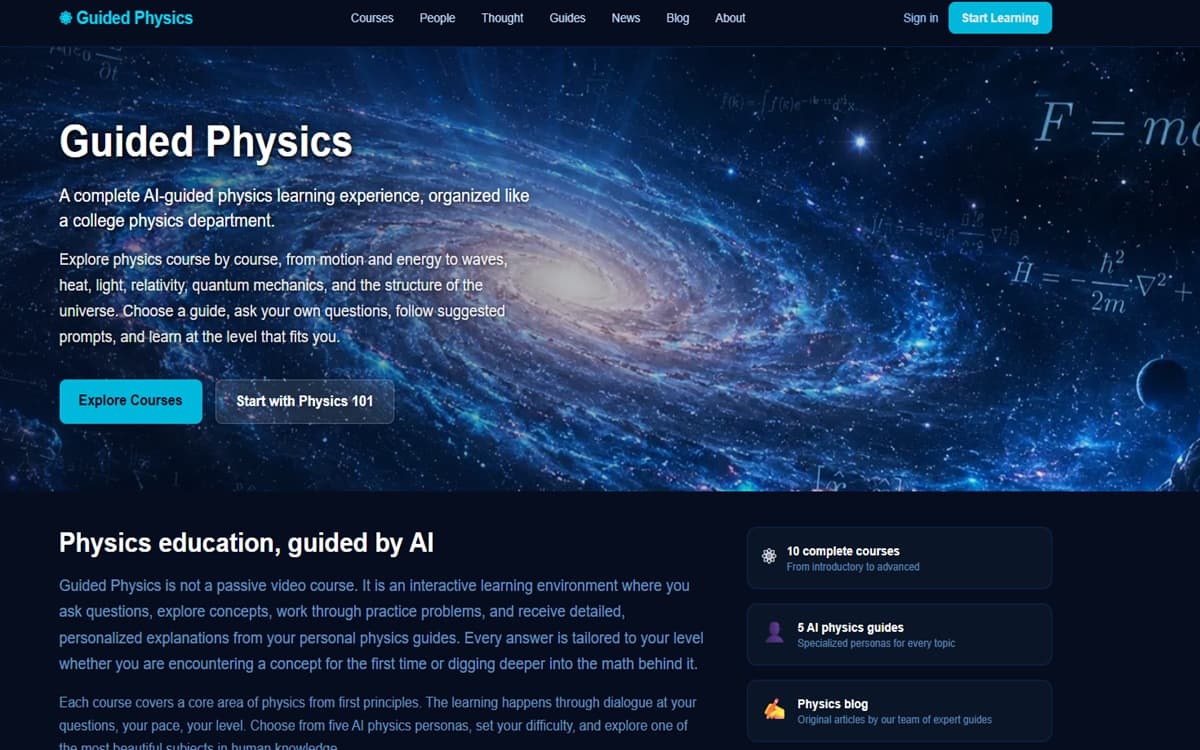
What GuidedPhysics does
GuidedPhysics presents physics as a subject you can enter one question at a time. The public site describes a complete AI-guided physics learning experience organized like a college physics department, with ten courses that move from first principles into classical mechanics, waves, thermodynamics, electricity and magnetism, optics, relativity, quantum mechanics, and astrophysics. The site’s strongest appeal is that it treats difficult ideas as learnable rather than intimidating.
The learning model is conversational. Visitors can choose an AI physics guide, set a difficulty level, ask questions, follow suggested prompts, and work through explanations that include equations, analogies, examples, and practice support. Course pages also provide structured modules, learning objectives, major topics, misconceptions, recommended next steps, and suggested questions, so the experience feels more guided than a generic chat box.
Who it may help
GuidedPhysics may help high school students preparing for physics, college students who want another explanation after class, homeschool families looking for structure, teachers seeking new ways to explain hard concepts, and adults who simply want to understand how the physical world works. The public site explicitly welcomes learners at different levels, from curious beginners to advanced undergraduates and math-heavy explorers.
The site may be especially helpful when a learner feels stuck. Physics often becomes frustrating when a person misses one step: a unit check, a sign convention, a hidden assumption, or a connection between the diagram and the equation. GuidedPhysics encourages patient exploration, hints before answers, first-principles reasoning, and the chance to ask the “basic” question without embarrassment.
How it connects to the AI revolution
AI Revolution Atlas looks at how artificial intelligence changes learning, work, creativity, and judgment. GuidedPhysics is a concrete education example because it shows AI acting as a responsive explainer. Instead of giving every learner the same page at the same pace, the site lets visitors adjust the guide, level, and question path. That makes AI feel less like a distant technology and more like a flexible learning companion.
The connection is also a useful reminder about good AI use. Physics learning still requires active effort. A learner needs to reason through the steps, check units, notice assumptions, compare answers with trusted course materials, and ask follow-up questions when something feels unclear. The site’s own public pages acknowledge that AI explanations can be imperfect, which supports a healthy pattern: use AI to explore, then verify important work.
Why visitors may enjoy it
The enjoyable part of GuidedPhysics is the sense of momentum. A visitor can start with a broad course, jump into a module, ask an AI guide a question, browse famous physicists, read a blog article, follow current physics news, or explore classic thought experiments. That variety makes the site feel like a living study hall rather than a static textbook.
The AI guide concept adds personality without distracting from the subject. Different guides focus on classical mechanics, electromagnetism and waves, quantum ideas, relativity and cosmology, or hands-on problem practice. That lets learners approach physics through the style that fits them best: step-by-step definitions, visual analogies, conceptual comfort with uncertainty, historical context, unit checks, experiments, or practice problems. The site’s thought experiments and people profiles add another layer by connecting formulas to the human story of discovery.
A practical next step
Start with the Introduction to Physics course and choose one concept that has always felt slippery: force, energy, fields, waves, relativity, or quantum behavior. Read the course overview, then ask the AI guide to explain the idea at your current level and give one simple example. After that, work through a practice-style question and check every unit.
That small loop captures the best use of GuidedPhysics. Let AI make the first explanation easier to enter, but stay active. Draw the diagram, write the equation, test the units, compare with your class notes or textbook, and ask one better follow-up question. For AI Revolution Atlas readers, GuidedPhysics is a welcoming example of how AI can turn a hard subject into a guided path for curiosity, confidence, and deeper understanding.
Evaluate thoughtfully
Is this tool a fit for your goals?
 Ask Dr. Mira