Guided Agentic AI
A guided learning path into AI agents, tools, memory, safety, and real-world workflows.
Visit Guided Agentic AI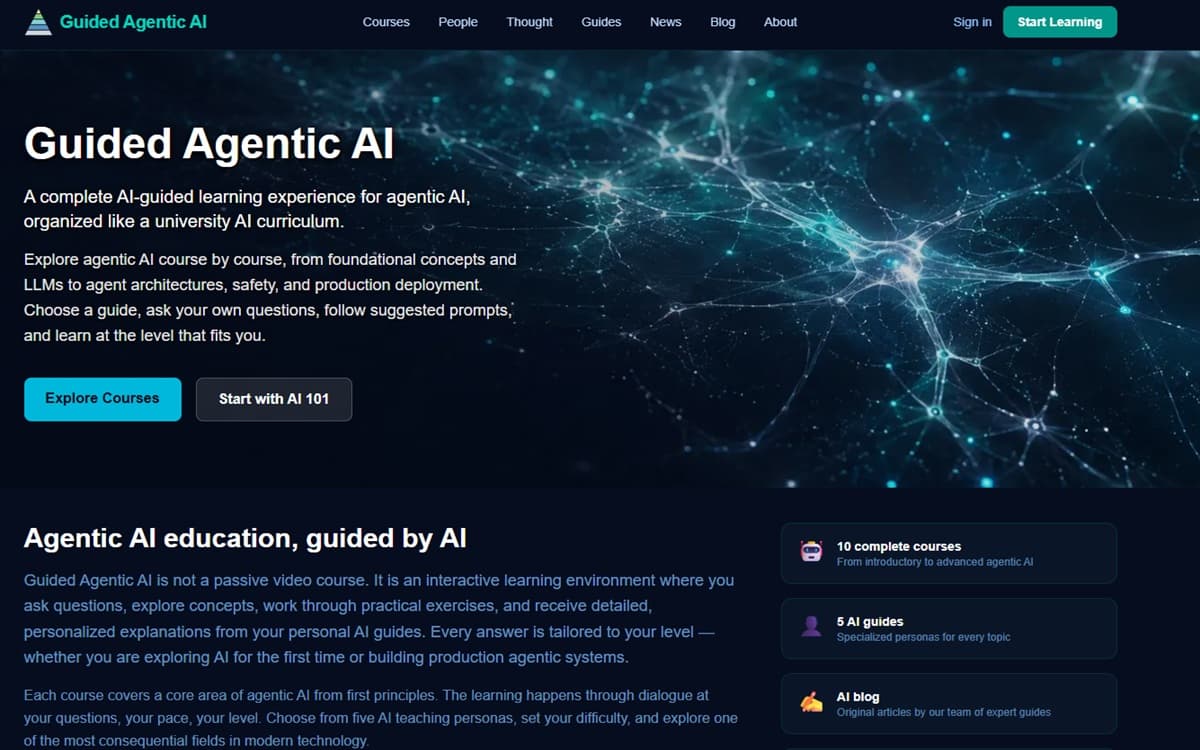
What Guided Agentic AI does
Guided Agentic AI is a learning site for understanding the shift from ordinary AI conversations to agent-like systems that can work through goals, steps, tools, memory, and multi-stage tasks. The public site presents a university-style curriculum with ten courses, beginning with foundations and moving through large language models, prompt engineering, tool use, function calling, agent architectures, memory and context management, multi-agent systems, safety and alignment, production agents, and real-world applications.
The experience is designed to feel interactive rather than passive. Visitors can browse structured lessons, choose an AI guide, set a difficulty level, ask questions, and use suggested prompts to keep learning. The site also includes people profiles, AI thought experiments, blog articles, curated resources, and AI news, giving learners several ways to build a mental model of agentic AI beyond a single lesson page.
Who it may help
Guided Agentic AI may help curious beginners who want agentic AI explained without assuming they already know the vocabulary. It may also help software developers, product managers, founders, educators, students, researchers, and self-directed learners who want a clearer map of where the field is going. The course paths make the site especially approachable because visitors can start with “I’m new to AI,” “I want to build my first agent,” “I want to understand how LLMs work,” “I’m interested in AI safety,” or “I’m deploying AI in production.”
That range is useful because agentic AI can sound abstract. The site translates the subject into understandable building blocks: What is an agent? What is the agent loop? Why do tools matter? What is memory? What can go wrong when an AI system acts with more autonomy? Those questions give learners a practical doorway into a fast-moving field.
How it connects to the AI revolution
AI Revolution Atlas explains the AI revolution as a shift in how people learn, work, automate, and make decisions. Guided Agentic AI fits that story because agentic systems are one of the clearest examples of AI moving beyond one-turn answers. Instead of only responding to a prompt, an agent-like workflow may break down a task, call tools, observe results, remember context, revise its plan, and coordinate with other agents.
That makes the site a strong learning bridge. It helps visitors move from “I use a chatbot” to “I understand the parts of a goal-directed AI system.” The distinction matters for anyone trying to follow future AI developments. Agentic AI discussions often involve planning, tool permissions, evaluation, observability, reliability, human-in-the-loop design, alignment, and production risk. Guided Agentic AI gives learners a vocabulary for those ideas while keeping human direction and verification in the frame.
Why visitors may enjoy it
The enjoyable part of Guided Agentic AI is the feeling of the field becoming organized. Agentic AI can seem like a blur of buzzwords, demos, frameworks, and predictions. The site turns that blur into a path. A visitor can begin with foundations, move into LLMs and prompts, then see how tools, memory, architectures, and multi-agent coordination fit together.
The AI guides add personality and choice. One guide leans toward model internals, another toward systems and production, another toward safety and governance, another toward practical engineering, and another toward multi-agent complexity. That makes the learning experience feel flexible: different learners can approach the same subject through the voice and style that fits them best. The thought experiments and AI history pages also add context, reminding visitors that today’s agentic systems grew from decades of questions about intelligence, computation, understanding, goals, and safety.
A practical next step
Start with the Introduction to Agentic AI course and treat the first visit as a vocabulary-building session. Read the course overview, then ask one simple question: What is the difference between a chatbot and an AI agent? After that, follow the suggested questions about the agent loop, memory, tools, and autonomy.
That first loop captures the value of the site. You do not need to master every framework immediately. Begin by building the mental model: a goal, a plan, tools, observations, memory, evaluation, and human oversight. Once those pieces are clear, the rest of the AI revolution becomes easier to follow because agentic AI stops feeling like a mystery and starts looking like a system you can inspect, question, and learn to design responsibly.
Evaluate thoughtfully
Is this tool a fit for your goals?
 Ask Dr. Mira