Goals To Systems
Turn big goals into repeatable systems, habits, and small next actions.
Visit Goals To Systems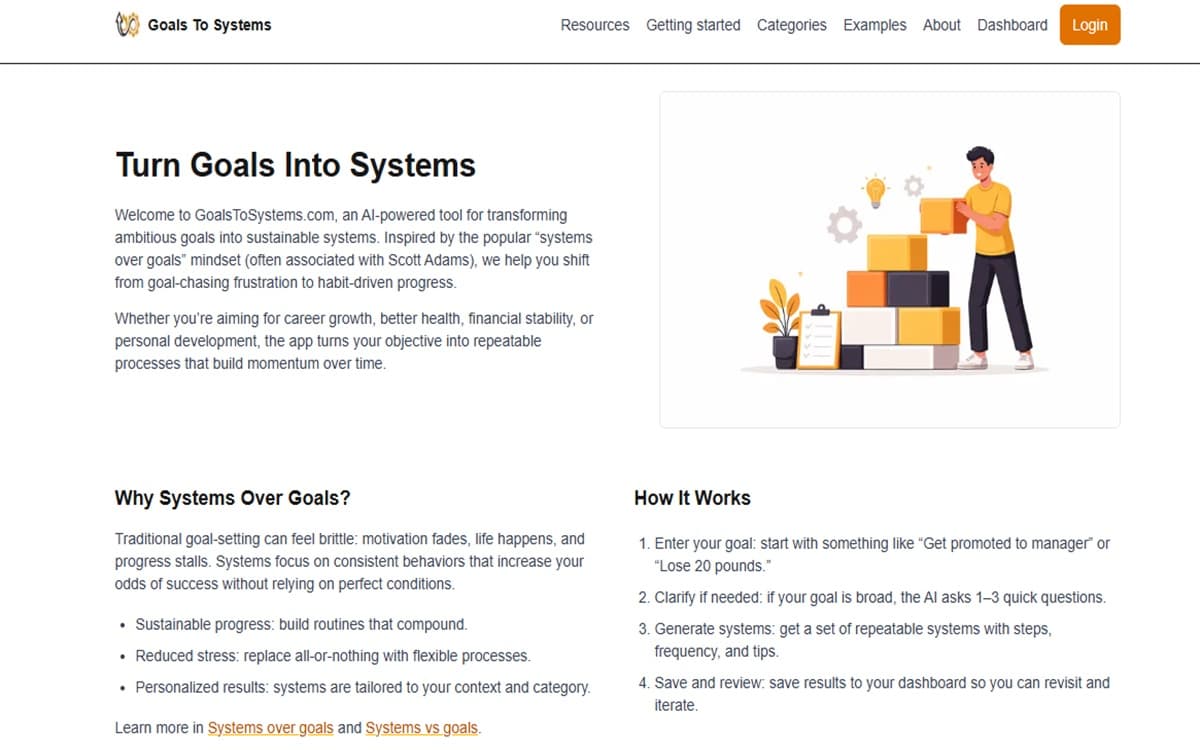
What Goals To Systems does
Goals To Systems is built around a motivating shift: stop staring only at the destination and start designing the routines that make progress more likely. The public site presents an AI-powered tool for turning goals into repeatable systems. A visitor begins with a goal, chooses a category, and can add notes. If the goal is broad, the tool says it may ask a few clarification questions before generating practical systems.
That framing makes the site easy to understand. Instead of treating “get promoted,” “lose weight,” “build an emergency fund,” or “learn a language” as a faraway finish line, Goals To Systems breaks the ambition into habits, checklists, frequencies, steps, and tips. Its public examples show the pattern clearly: daily deep work, weekly reviews, automated savings, meal prep rituals, light tracking, feedback loops, and small repeatable actions that can survive busy weeks.
Who it may help
Goals To Systems may help people who are tired of abandoned resolutions but still want to improve something meaningful. It can be useful for professionals planning career growth, students building study habits, people working on health and fitness routines, families trying to strengthen relationships, and anyone looking for a calmer personal-growth plan.
It may also help people who think better with structure. A blank goal can feel intimidating because it asks for a future outcome without showing the daily path. A system feels more approachable because it answers a different question: what should I do this week, and how can I make it repeatable? The site’s categories and example transformations make that shift concrete.
How it connects to the AI revolution
AI Revolution Atlas explains that AI is changing how people plan, learn, automate, and make decisions. Goals To Systems is a practical example because it uses AI as a planning partner, not a life boss. The AI can help decompose a goal, ask for missing context, suggest routines, and turn a vague wish into a more usable set of actions. The human still decides what fits their values, schedule, energy, responsibilities, and real constraints.
That balance is a useful AI-literacy lesson. AI can make planning less lonely and less abstract, but it cannot know every trade-off in a person’s life. A good system should be tested, adjusted, simplified, or rejected when reality disagrees. The site’s emphasis on iteration, lightweight tracking, habit stacking, and energy management fits the larger idea that AI-supported planning works best when people keep reflecting and adapting.
Why visitors may enjoy it
The enjoyable part of Goals To Systems is the feeling of relief. A big goal can create pressure. A system creates motion. Visitors can browse examples and see how ordinary ambitions become simple operating patterns: a 30-minute growth plan, a biweekly manager check-in, a weekly expense review, a daily walk, a family check-in, or a 15-minute app session for language practice.
The resource library adds another friendly layer. Guides on systems versus goals, habit stacking, energy management, and lightweight tracking help explain why small repeated behaviors can be more sustainable than all-or-nothing goal chasing. The tone is practical and encouraging rather than overwhelming. It invites visitors to start small, reduce friction, and keep adjusting the process as life changes.
A practical next step
Visit with one real goal in mind, but phrase it honestly. Instead of polishing it into a perfect productivity slogan, include the messy details that matter: your category, available time, biggest obstacle, energy pattern, and what has failed before. Then study the resulting systems as a draft plan.
The best next move is to choose one system, shrink it to a version you can actually run this week, and test it. If it works, keep it. If it feels too heavy, revise it. That is the promise of Goals To Systems: AI can help you turn aspiration into a starting structure, while you remain the author of the life it must fit.
Evaluate thoughtfully
Is this tool a fit for your goals?
 Ask Dr. Mira