Belief Atlas
A calm, psychology-first atlas for understanding why thoughtful people disagree.
Visit Belief Atlas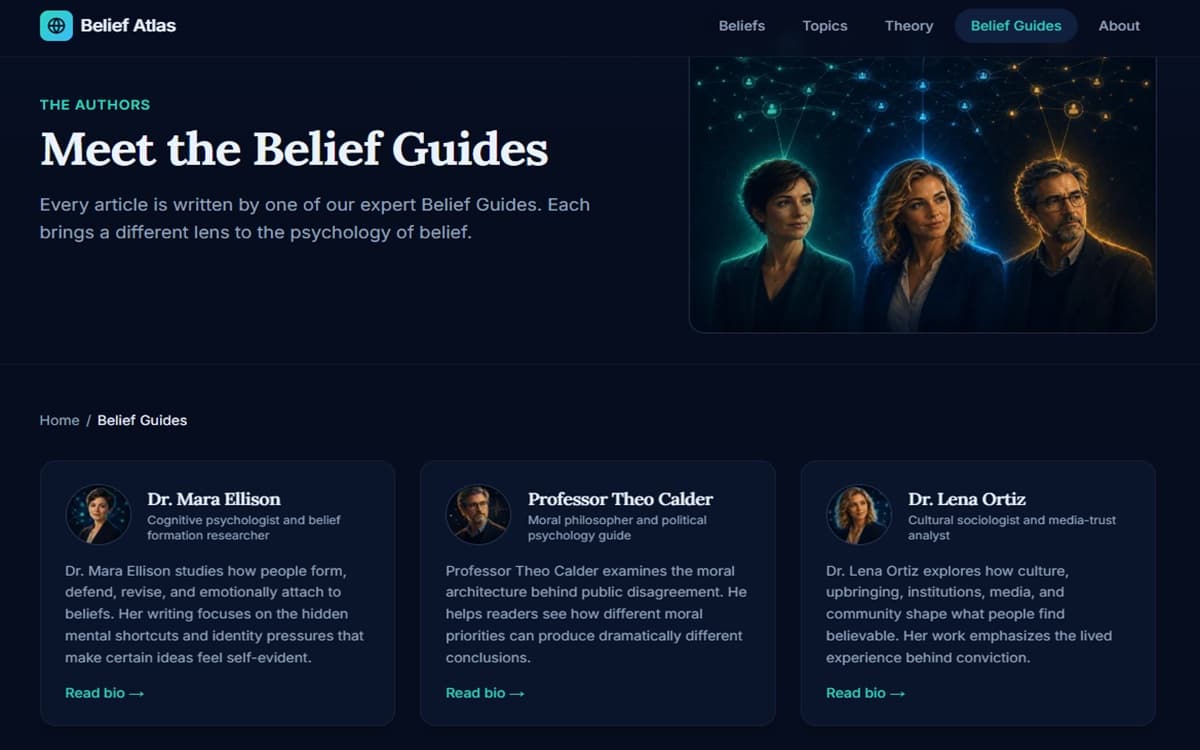
What Belief Atlas does
Belief Atlas is a psychology-first guide to why sincere people can reach opposite conclusions. Its core promise is not to settle every argument or tell readers which side should win. Instead, it slows the argument down and asks a more human question: what moral instincts, identity needs, life experiences, trust networks, fears, hopes, and habits of reasoning make a belief feel true to the person who holds it?
The site organizes belief articles across politics, economics, culture, science and trust, religion and origins, and morality and law. Each article focuses on one surface belief, explains it in plain English, and then maps its deeper structure through a Belief X-Ray. That structure may include the moral center, psychological drivers, trust context, and a bridge question that can open a better conversation. Many articles also point readers toward the opposite belief, making the site feel like an atlas of disagreement rather than a collection of one-sided essays.
Who it may help
Belief Atlas may help readers who are tired of arguments that begin with contempt. Students can use it to understand a debate before writing or speaking. Teachers and discussion leaders can use it to introduce steelmanning, media framing, motivated reasoning, identity-protective cognition, and trust networks in accessible language. Writers can use it to build fairer characters and stronger arguments. Curious readers can use it when they want to understand a view they may never share.
Its best audience may be people who want to disagree more intelligently. The site does not ask visitors to surrender their convictions. It asks them to notice that convictions often come from more than facts alone. Beliefs can be shaped by group belonging, moral priorities, personal memories, trusted authorities, and the stories people use to make sense of the same event.
How it connects to the AI revolution
AI Revolution Atlas explores the technological side of change, but the AI revolution is also a human story. New tools do not arrive in a vacuum. People interpret them through identity, incentives, trust, fear, hope, prior experience, and the communities that tell them what the technology means. Belief Atlas helps make that human layer visible.
That connection is especially useful for AI literacy. Public disagreement about artificial intelligence often includes real technical questions, but it also includes deeper disagreements about authority, risk, work, creativity, fairness, safety, and control. Belief Atlas offers a way to practice asking better questions before reaching for a quick conclusion. Who feels protected by this change? Who feels threatened? Which institutions are trusted? Which values are being defended? AI can help generate explanations, but human judgment is still needed to test whether those explanations are fair, accurate, and useful.
Why visitors may enjoy it
The enjoyable part of Belief Atlas is its calm curiosity. A visitor can pick a charged topic and find writing that treats the belief as understandable without automatically treating it as correct. That distinction gives the site its personality. It creates room for empathy without requiring agreement.
The recurring Belief Guides add another layer of appeal. Each guide brings a different lens: cognitive psychology, moral philosophy, political psychology, cultural sociology, and media trust. The theory library then gives visitors a vocabulary for patterns they may already sense in everyday life. Concepts such as confirmation bias, sacred values, trust and authority, and “two movies, one screen” make disagreement easier to name and discuss.
A practical next step
Start with one belief you strongly disagree with. Read it slowly, not to be persuaded, but to see whether you can explain why it feels compelling to someone else. Then open its paired opposite belief and compare the moral center, psychological drivers, trust networks, and bridge questions.
That small exercise captures the value of Belief Atlas. It turns disagreement into a map. For AI Revolution Atlas readers, it is a useful reminder that understanding the future of technology requires understanding people: their assumptions, their fears, their loyalties, their sources of trust, and their hope that someone will finally understand why the world looks the way it does from where they stand.
Evaluate thoughtfully
Is this tool a fit for your goals?
 Ask Dr. Mira