Balanced Debate
A friendly AI debate arena for seeing more than one side of important questions.
Visit Balanced Debate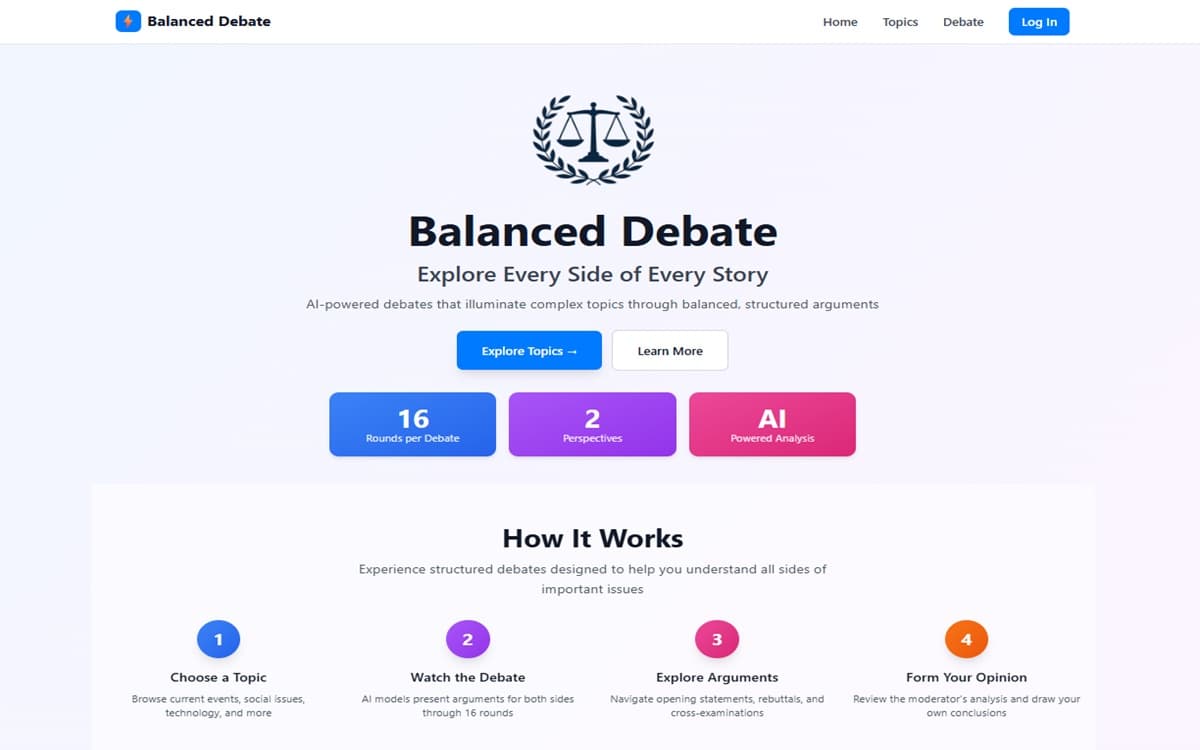
What Balanced Debate does
Balanced Debate is built around a simple but valuable promise: important questions become easier to understand when the main arguments are organized side by side. The public site presents itself as an AI debate arena that helps visitors explore every side of every story through balanced, structured arguments. Instead of treating a topic as a quick answer, it frames debate as a process: choose a subject, examine competing viewpoints, and use the structure to think more carefully.
The public topic pages point to a wide range of issues, including politics, policy, rights, economics, culture, science, technology, environment, animal testing, school uniforms, voting age, capitalism and socialism, globalism and nationalism, and the four-day work week. Some public pages show that in-depth written analysis has not yet been added for every topic, so the strongest verified promise is the site’s structured, AI-assisted debate experience and topic discovery.
Who it may help
Balanced Debate may help students who need to understand arguments before writing an essay, discussion leaders looking for a clear starting point, and curious readers who want to test an opinion against its strongest counterpoint. It may also help writers, creators, and educators prepare for conversations where people disagree but still need a shared map of the issue.
The site is especially useful for anyone who feels overwhelmed by public arguments. Online disagreement often arrives as fragments: slogans, reactions, headlines, and one-sided claims. Balanced Debate offers a calmer starting frame. It encourages visitors to pause, name the question, and compare how different sides might reason through evidence, values, trade-offs, and consequences.
How it connects to the AI revolution
AI Revolution Atlas explains that AI is not only about automation. It is also about new ways to organize complexity. Balanced Debate fits that theme because it shows AI being used as a structure-builder rather than just an answer machine. A helpful debate tool does not need to declare a winner for the reader. Its value can come from arranging the landscape so a person can think more clearly.
That is an important AI-literacy lesson. When AI helps with debate, the human user still needs judgment. Readers should ask whether each side is represented fairly, whether evidence is missing, what assumptions shape the framing, and which claims need verification from reliable sources. Used responsibly, a debate platform can support critical thinking by making disagreement more visible, more organized, and easier to inspect.
Why visitors may enjoy it
The enjoyable part of Balanced Debate is the relief of order. A big public question can feel messy until someone breaks it into sides, claims, and themes. The site’s appeal comes from that shift: visitors can move from a swirl of opinion to a clearer debate frame. That makes exploration feel less combative and more educational.
It also invites intellectual humility. A visitor may arrive with a strong view and leave with a better understanding of why someone else sees the issue differently. That does not mean every argument is equally strong or every claim is equally supported. It means the first step toward better judgment is often understanding the structure of disagreement. Balanced Debate turns that step into an accessible browsing experience.
A practical next step
Start with one topic you already care about and one topic outside your usual interests. For each, identify the central question, the main argument on each side, and the value conflict underneath the disagreement. Then choose one claim that seems important and check it against outside evidence.
That simple practice captures the best use of Balanced Debate. Treat it as a launch point for reflection, discussion, and research. It can help you prepare for a class, a post, a meeting, or a thoughtful conversation, but the final work remains yours: weigh the evidence, notice the trade-offs, and decide what you think after seeing more than one side.
Evaluate thoughtfully
Is this tool a fit for your goals?
 Ask Dr. Mira