Alternate History AI
A playful AI gateway into history’s most fascinating “What if?” moments.
Visit Alternate History AI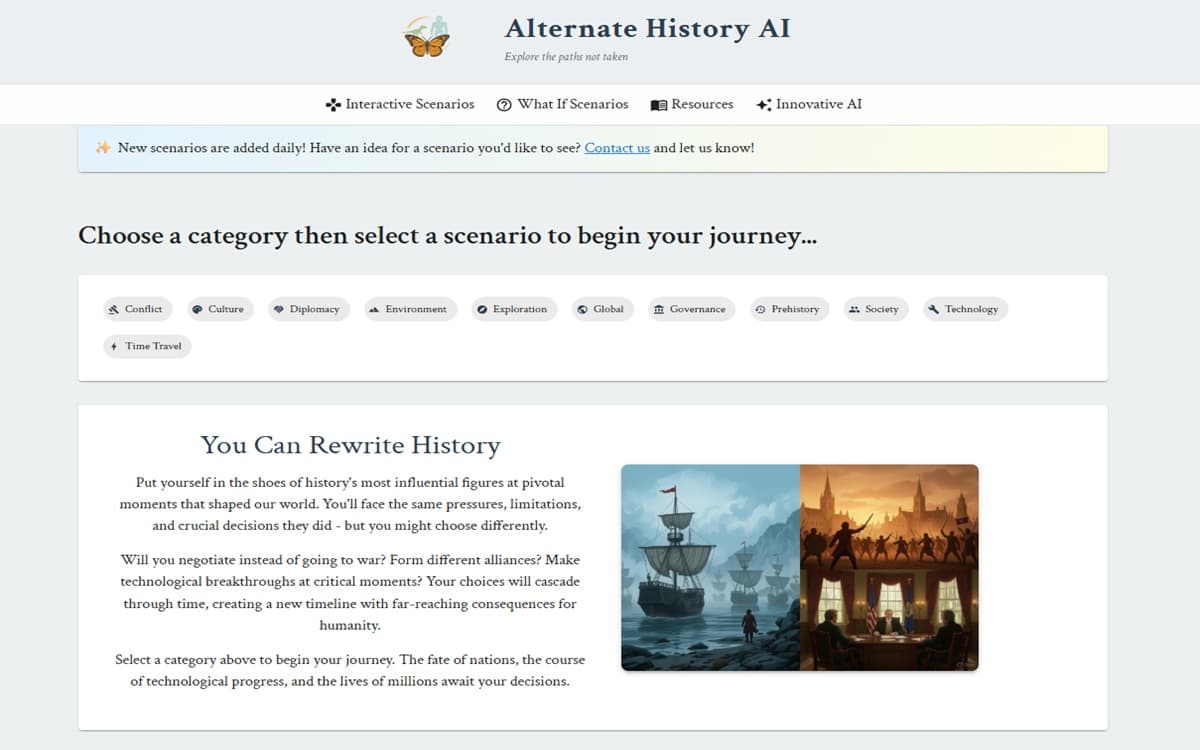
What Alternate History AI does
Alternate History AI is built around one of the most magnetic questions in learning: What if history had gone another way? The public site presents itself as an interactive AI-powered platform for exploring alternate historical timelines. Its featured scenarios begin with familiar turning points, then invite visitors to imagine choices that could redirect events, alliances, technologies, cultures, and consequences.
The experience is easy to understand from the outside. A visitor can start with a historical moment such as the Battle of Hastings, the American Declaration of Independence, the assassination of Archduke Franz Ferdinand, the atomic bomb decision, the fall of the Berlin Wall, the Civil War, the Library of Alexandria, early human evolution, the KT extinction event, or Facebook’s early expansion. Each example gives a short historical setup, a dramatic choice point, and a counterfactual question that turns the real event into a branching thought experiment.
Who it may help
Alternate History AI may help curious history readers who enjoy learning through scenarios rather than memorizing timelines. It is especially useful for people who ask why events unfolded the way they did. A good counterfactual does not replace documented history. It can make the real history more interesting by pushing the reader to notice causes, constraints, risks, and second-order effects.
The site may also appeal to teachers, students, writers, game designers, and worldbuilding fans. A classroom discussion could begin with a scenario and then move back to the evidence: What was actually possible? Which forces were already in motion? Which individual decisions mattered, and which larger systems limited the options? For creative writers, the site’s prompts can serve as sparks for stories, timelines, debates, or research questions.
How it connects to the AI revolution
AI Revolution Atlas explains AI as a major shift in how people learn, create, and explore ideas. Alternate History AI is a memorable example because it uses generative AI in a playful but educational direction. The promise is not simply that AI can produce text. The promise is that AI can help people ask richer questions, compare possibilities, and see history as a web of causes and consequences.
That matters for AI literacy. Generative AI is strongest when users understand the difference between exploration and verification. Alternate history belongs on the exploration side. It can stretch imagination, reveal assumptions, and make patterns easier to discuss, but it should stay clearly separate from the factual record. Used that way, the site becomes a useful demonstration of responsible creative AI: engaging, speculative, and curiosity-building, while still inviting readers to return to real sources.
Why visitors may enjoy it
The fun of Alternate History AI is the feeling of stepping into a hinge moment. Instead of reading history as a fixed parade of dates, visitors are asked to pause at a decision point and imagine the pressure of choice. Should a leader negotiate, retreat, resist, preserve knowledge, expand a platform, or change course? A single question can turn a familiar event into an intellectual adventure.
The range of scenarios also keeps the site lively. It moves from ancient knowledge to medieval conquest, from revolutions and wars to the Cold War, human origins, mass extinction, and the internet age. That breadth makes the portfolio feel imaginative without being random. Each scenario has a clear hook, a concise setup, and a question that invites the reader to think about what might have happened next.
A practical next step
Start with one scenario you already know well, then choose one you know less about. Read the setup, consider the alternate choice, and write down two lists: what might change quickly and what might resist change. Then return to the real history and look for the forces that made the actual outcome happen.
That simple exercise captures the value of the site. Alternate History AI is not just about inventing a different past. It is about using imagination to sharpen curiosity. For AI Revolution Atlas readers, it offers a welcoming way to see generative AI as a partner in scenario-building, creative learning, and better historical questions.
Evaluate thoughtfully
Is this tool a fit for your goals?
 Ask Dr. Mira